Before you buy
Sample and assessment method
This page shows the certificate with sample data, the questions and mandatory requirements of each standard, an example result and the page where your customers check the certificate.
01: Certificate
What your certificate shows
The image shows the real layout with sample data. You receive the certificate as a PDF.
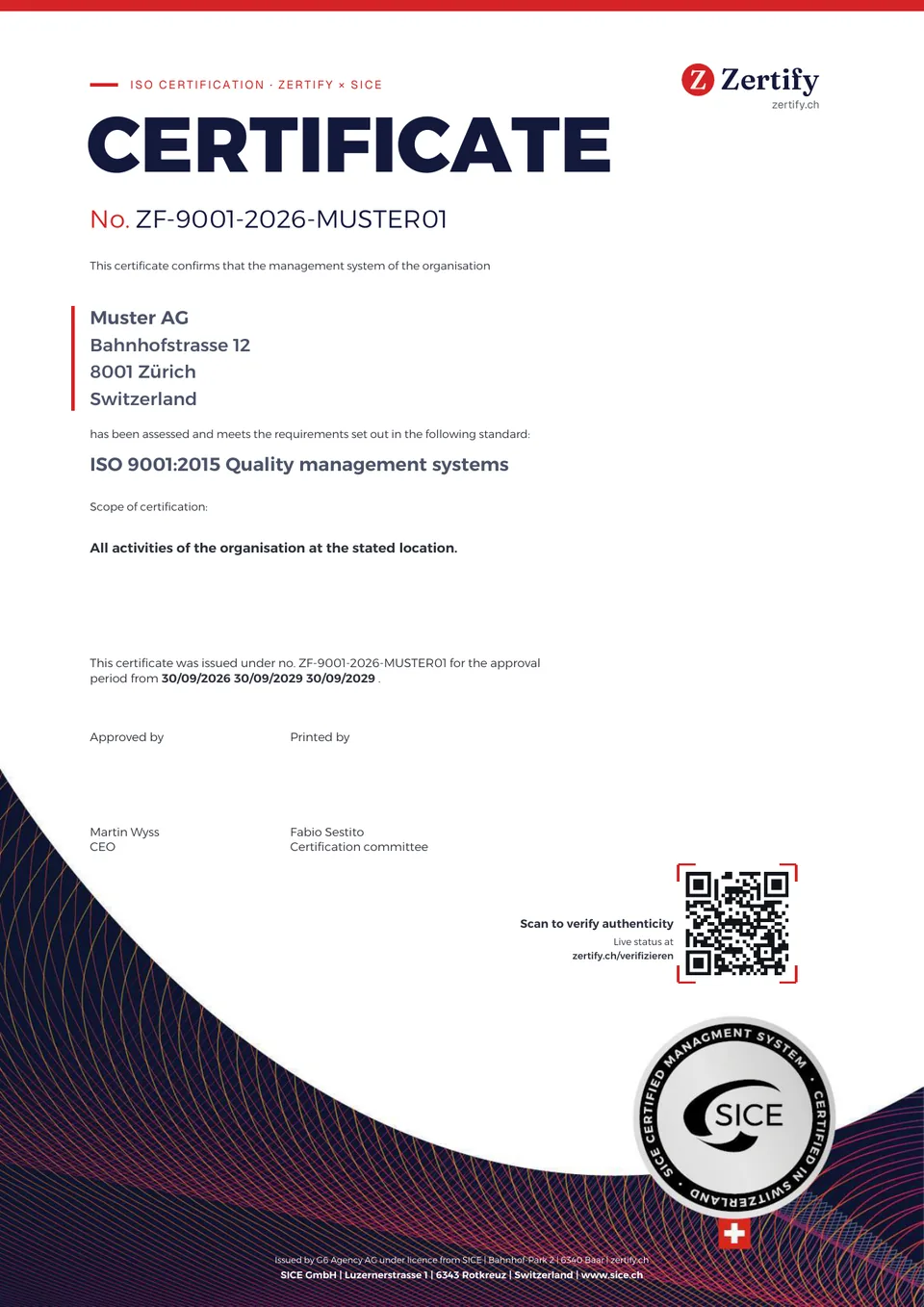
Sample with example data, without signatures
Company name and address
Exactly as you enter them when you start the assessment.
Standard
The standard with its edition, for example ISO 9001:2015.
Scope
The activities the certificate covers. The default is: All activities of the organisation at the stated location.
Certificate number
Unique to each certificate. Anyone can use it to find the certificate on the verification page.
Validity
Issue date and expiry date, three years apart.
Validity and re-audit
The yearly online re-audit is not printed on the PDF. The verification page shows whether the certificate is valid today.
QR code
Leads to the public verification page zertify.ch/en/verify/ with your certificate number.
SICE seal and issuer
The SICE seal and the note that G6 Agency AG issues the certificate under licence from SICE.
02: Method
How the certificate comes about
It rests on your answers in the online self-assessment. The SICE Certification Board reviews them.
32 to 48 yes/no questions per standard
The questions follow the clauses of the standard. Broad standards such as ISO 27001 have more of them. Questions on mandatory requirements are marked in the assessment.
Immediate result
After the last question you see your result per topic and the open points. You can order once all mandatory requirements are met and at least two thirds of the other questions are answered yes.
Truthful answers
The certificate rests on your answers. Under the terms and conditions you undertake to complete the assessment truthfully and in full.
Review by the SICE Certification Board
A member of the SICE Certification Board reviews every assessment before issuance. The review checks whether the answers are plausible and consistent, whether the company data is correct and whether the scope fits the business. Implausible or false answers lead to questions or a refusal. A certificate is suspended or revoked if answers turn out to be false, if the yearly re-audit is failed or more than 30 days overdue, or if the certificate is misused. All answers are online and no site visit is needed, so the review is usually completed within 4 hours.
No on-site audit
Nobody visits your premises. What gets reviewed is what you state in the assessment.
03: Questions
Questions and mandatory requirements per standard
The assessment is passed when all mandatory requirements are answered yes and at least two thirds of the other questions, rounded up. A single no on a mandatory requirement and the assessment fails. The figures come straight from the question catalogue the assessment uses.
| Standard | Questions | Mandatory | Other | Topics |
|---|---|---|---|---|
| ISO 9001:2015 | 36 | all 11 | min. 17 of 25 | 7 |
| ISO 14001:2015 | 34 | all 14 | min. 14 of 20 | 7 |
| ISO 27001:2022 | 48 | all 13 | min. 24 of 35 | 11 |
| ISO 45001:2018 | 34 | all 14 | min. 14 of 20 | 7 |
| ISO 20000-1:2018 | 36 | all 13 | min. 16 of 23 | 7 |
| ISO 50001:2018 | 32 | all 13 | min. 13 of 19 | 8 |
| ISO 27017:2015 | 34 | all 12 | min. 15 of 22 | 8 |
| ISO 27018:2019 | 32 | all 11 | min. 14 of 21 | 8 |
| ISO 42001:2023 | 40 | all 13 | min. 18 of 27 | 10 |
| ISO 27701:2019 | 38 | all 13 | min. 17 of 25 | 10 |
| ISO 22301:2019 | 34 | all 13 | min. 14 of 21 | 10 |
| ISO 37001:2016 | 34 | all 13 | min. 14 of 21 | 9 |
Example ISO 9001: questions per topic
- Context of the organization4 questions1 mandatory
- Leadership5 questions1 mandatory
- Planning4 questions2 mandatory
- Support8 questions2 mandatory
- Operation7 questions2 mandatory
- Performance evaluation4 questions2 mandatory
- Improvement4 questions1 mandatory
The topics follow clauses 4 to 10 of the standard.
04: Result
What your result looks like
The result appears right after the last question, before any payment. The example shows the structure.
Example with sample data
ISO 9001:2015
Score
32 / 36
- Mandatory requirements
- 11 of 11 met
- Other requirements
- 21 of 25 (at least 17)
All mandatory requirements and enough other requirements met.
Result per topic
- Context of the organization4 / 4
- Leadership5 / 5
- Planning4 / 4
- Support8 / 8
- Operation5 / 7
- Performance evaluation4 / 4
- Improvement2 / 4
Open points
Questions answered with no. Excerpt: 2 of 4.
- Is there a controlled process for design and development?
- Is there a process for continual improvement?
05: Validity
After issuance
The certificate is valid for three years from issuance, provided you pass the re-audit every year.
- Yearly online re-audit
- Once a year you complete a short online re-audit in your customer account. It is included in the annual fee.
- Reissue after three years
- After three years the certificate is reissued as long as your subscription runs.
- Overdue re-audit
- If the re-audit is more than 30 days overdue, the verification page shows the certificate as suspended until the re-audit is passed.
- Revocation
- G6 Agency AG may revoke a certificate, for example if the assessment contained false or misleading information, if the certificate or badge is misused or if the terms and conditions are materially breached. The verification page then shows the certificate as revoked.
06: Verification
How your customers verify the certificate
The QR code on the PDF leads to the public verification page at zertify.ch/en/verify/ with your certificate number. It shows the company, standard, issue date and expiry date.
The status is always current: valid, expired, suspended or revoked. Without the QR code, you type the certificate number into the verification page. No login needed.
07: Add-ons
Samples of the add-ons
This is what the document templates and the audit report look like. Both samples belong to the fictional Muster AG in Zurich, ISO 9001, with the same self-assessment answers.
Sample
Document templates
CHF 249per standard
One PDF per standard, prefilled with your company data and answers. Where a fact is missing, it says [to be completed], so you see what is left to add.
Included
- Cover page with company, address, scope and table of contents
- Policy with principles, responsibilities and approval fields
- Objectives with indicators and an action plan
- Risk register with rating, treatment and status
- Core procedures such as document control, internal audit, corrective action and management review
- For ISO/IEC 27001 and related standards, a Statement of Applicability as well
As a PDF by email and in your account.
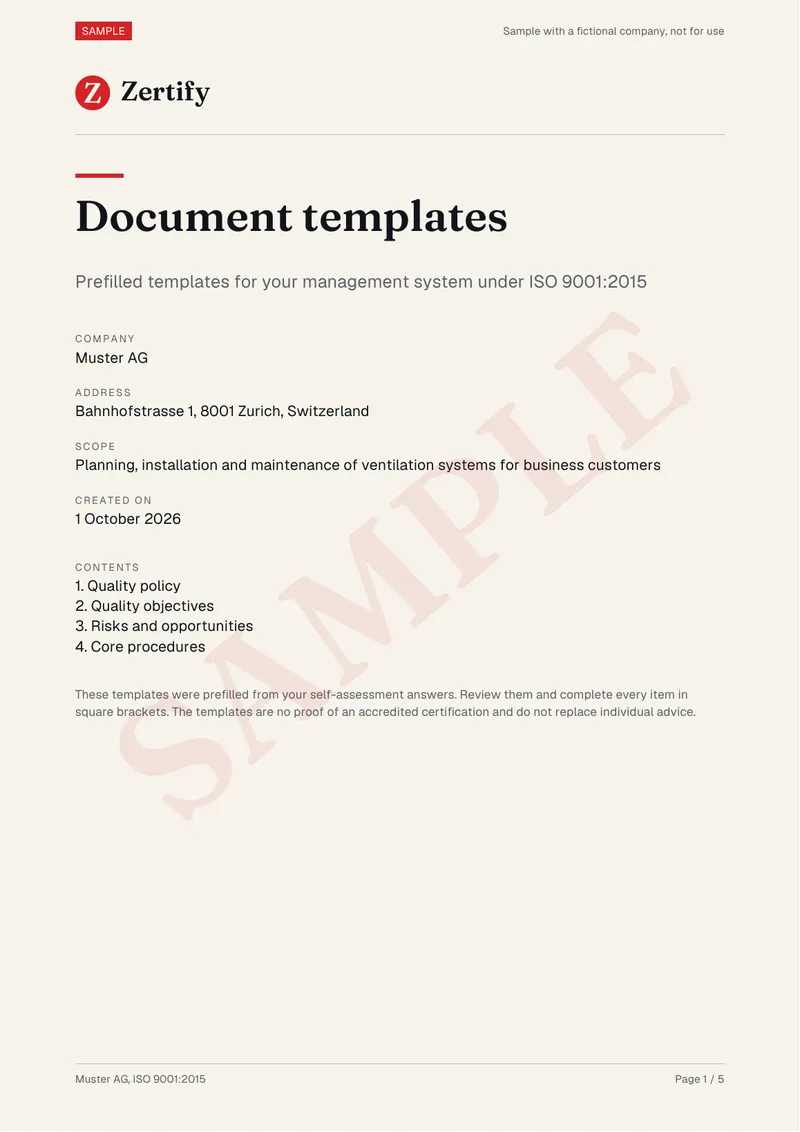
Cover page
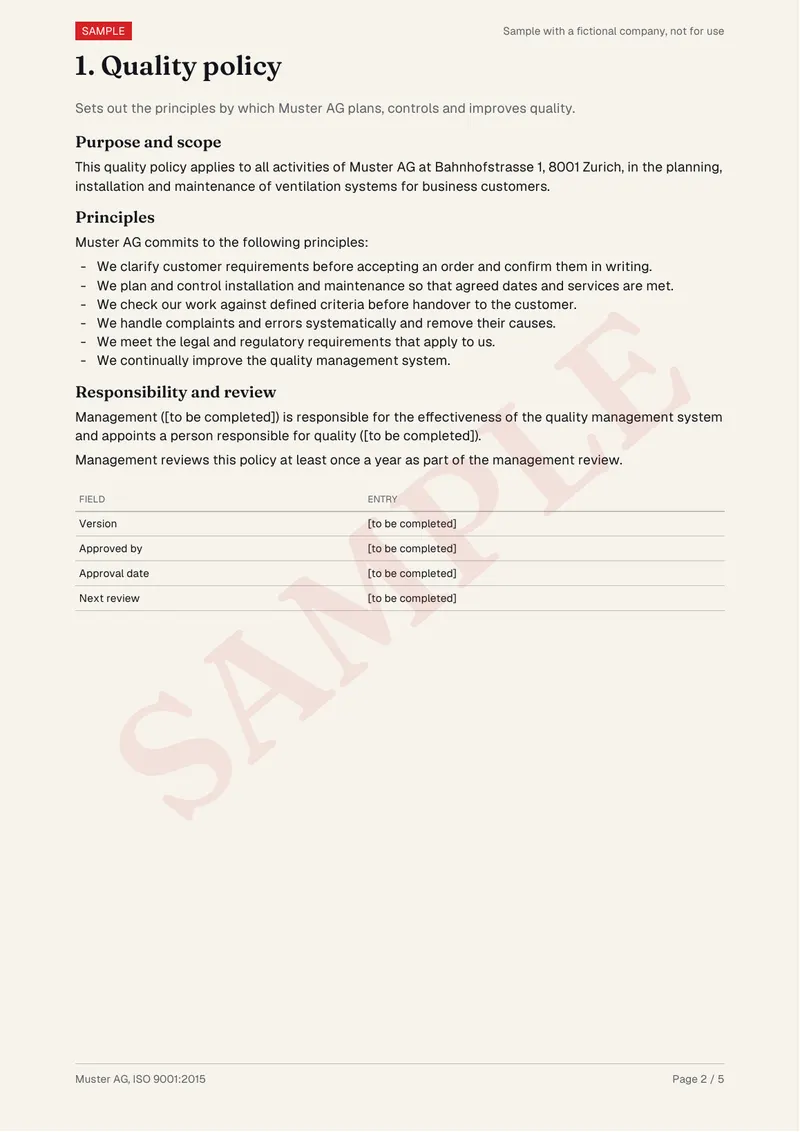
Quality policy
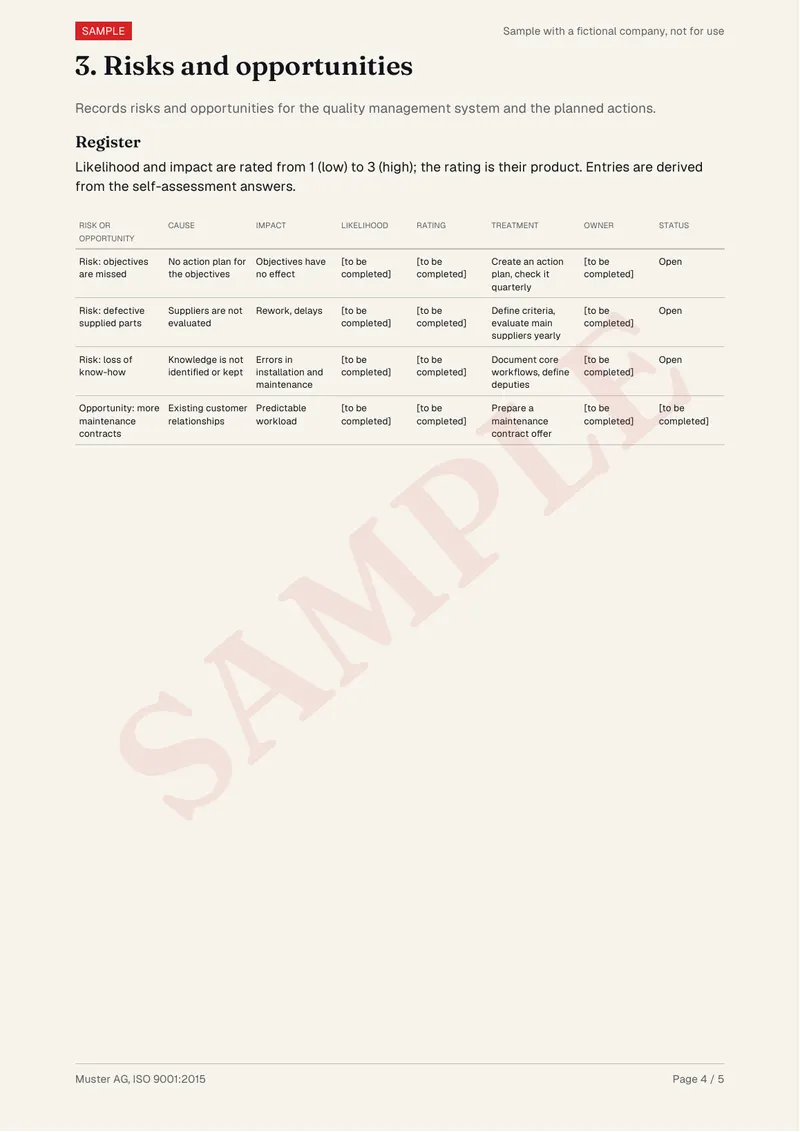
Risk register
Sample
Audit report
CHF 199each
A detailed report on your answers. It assesses every chapter of the standard, names strengths and ranks the gaps by priority.
Included
- Summary with score and mandatory requirements
- Assessment by chapter with every question and answer
- Strengths
- Recommended actions by priority, each tied to an answer
- Next steps
Online in your account. You get an email as soon as it is ready.
Summary
This report is based solely on the answers Muster AG gave in the ISO 9001:2015 self-assessment. The answers were not verified on site by an auditor. This report is not an accredited audit.
Muster AG answered 33 of 36 questions with yes. All 11 mandatory requirements are met (11 of 11). The quality management system is well covered in leadership, operation and improvement.
Gaps remain in planning how to achieve the quality objectives, in evaluating external providers and in keeping organisational knowledge.
Assessment by chapter
Context of the organization (4/4)
- Has your organization determined the internal and external issues relevant to its purpose? Yes
- Are the requirements of interested parties (customers, suppliers, authorities) identified on a regular basis? Yes
- Is the scope of your quality management system documented and justified? Yes
- Are your business processes managed as an interrelated system? Yes
Leadership (5/5)
- Does top management take accountability for the effectiveness of the quality management system? Yes
- Is there a documented quality policy that is communicated? Yes
- Are responsibilities and authorities clearly assigned and communicated? Yes
- Does leadership actively promote customer focus? Yes
- Are quality objectives reviewed regularly and adjusted where necessary? Yes
Planning (3/4)
- Are risks and opportunities identified and addressed systematically? Yes
- Are there measurable quality objectives for relevant functions and processes? Yes
- Are changes to the quality management system planned and carried out in a controlled manner? Yes
- Is there an action plan for achieving the quality objectives? No
Support (7/8)
- Are sufficient resources available for the quality management system? Yes
- Is the competence of employees determined and ensured? Yes
- Are all employees aware of their role in the quality management system? Yes
- Are there defined internal and external communication channels? Yes
- Is documented information appropriately controlled and protected? Yes
- Is the infrastructure (buildings, equipment, IT) maintained? Yes
- Are measuring and test instruments calibrated or verified where the results are critical for quality? Yes
- Is the knowledge needed for your processes determined, maintained and shared where needed? No
Operation (6/7)
- Are production and service delivery processes planned and controlled? Yes
- Are customer requirements reviewed and confirmed before an order is accepted? Yes
- Is there a controlled process for design and development? Yes
- Are external providers (suppliers) evaluated and monitored? No
- Are nonconforming products and services identified and controlled? Yes
- Are products and services checked against defined criteria before release to the customer? Yes
- Is traceability of products and services ensured where it is required? Yes
Performance evaluation (4/4)
- Is customer satisfaction measured and analyzed regularly? Yes
- Are internal audits carried out according to a planned programme? Yes
- Does management conduct regular management reviews? Yes
- Are process indicators and the performance of external providers analysed and used for decisions? Yes
Improvement (4/4)
- Are nonconformities handled systematically and corrective actions taken? Yes
- Is there a process for continual improvement? Yes
- Are improvement opportunities identified and implemented proactively? Yes
- Are customer complaints recorded, investigated for causes and turned into improvements? Yes
Strengths
- Top management takes responsibility for the system, and the quality policy is documented and communicated.
- Customer requirements are reviewed before an order is accepted, and outputs are checked against defined criteria before release.
- Nonconformities and customer complaints are recorded systematically and turned into improvements.
- Internal audits and management reviews take place as planned.
Recommended actions
- Create an action plan for the quality objectives. The question on an action plan was answered no. Without a plan with owners and dates, the measurable objectives have no effect.
- Evaluate and monitor external providers. According to the answers, suppliers are not evaluated. Define criteria and evaluate the main suppliers at least once a year.
- Identify and keep organisational knowledge. According to the answers, the knowledge the processes need is not identified or kept. Write down core workflows and define deputies.
Next steps
- Assign owners and dates to the three recommended actions.
- Check their implementation in the next internal audit.
- Include the results in the next management review.
See your own result
The assessment costs nothing. You only pay once you have passed and order the certificate.
Issued by G6 Agency AG under licence from SICE, publicly verifiable.