ISO 50001:2018
Apply for ISO 50001 online.
ISO 50001:2018 Energy Management
Check how systematically your business records energy consumption and tracks savings. You complete the self-assessment online, with no on-site audit. A member of the SICE Certification Board reviews your answers before the certificate is issued.
CHF 749 in the first year, then CHF 499 per year with an online re-audit.
Pricing- Questions
- 32
- Must-meet questions
- all 13
- Other questions
- min. 13 of 19
- Validity
- 3 years
- First-year price
- CHF 749
- From year 2
- CHF 499 per year
- Assessment time
- about 30 minutes
- Certificate after payment
- usually within 4 h
- Official standard
- iso.org
01: Overview
What is ISO 50001?
ISO 50001:2018 sets the requirements for an energy management system (EnMS). A business analyses its energy use, finds the big consumers and the savings, and keeps improving its energy efficiency. That lowers energy costs and greenhouse gas emissions.
02: Benefits
What ISO 50001 brings your business
The benefits of the standard come from an effectively implemented management system, not from the certificate alone. The Zertify certificate documents your reviewed answers.
- Lower energy costs once measures are implemented
- Lower CO2 emissions
- A structure for implementing energy efficiency requirements
- Data and action plans that funding programmes often ask for
- Answers for customers with sustainability requirements
- Find savings with a fixed method
03: Who it is for
Who is ISO 50001 for?
- Energy-intensive industry
- Manufacturing companies
- Building management and facility services
- Logistics and transport
- Public institutions
- Companies with high energy costs
04: Requirements
Key requirements
Establish an energy baseline
Identify significant energy uses
Define energy performance indicators (EnPIs)
Set energy objectives and action plans
Procure energy-efficient products and services
Monitor and improve energy performance
05: Demand
Who asks for ISO 50001?
ISO 50001 is asked for where energy is a large cost block or where authorities and customers want to see savings proven.
- Energy intensive businesses
- Production, data centres and logistics with high consumption use the system to cut usage and control costs.
- Target agreements and levies
- Anyone who commits to energy savings, for example in cantonal large consumer models or for exemption from the CO2 levy, can use energy management as a foundation.
- Corporations and supply chains
- Large companies with climate targets ask suppliers about energy use and reduction plans, mainly for their sustainability reports.
06: Assessment
How the assessment works
The assessment has 32 yes/no questions, online and at your own pace. 13 of them are must-meet questions of our assessment and must all be answered yes. Of the other 19 questions you need at least 13 yes.
| The questions fall into these topics: | Questions | Mandatory |
|---|---|---|
| Context of the organization | 4 questions | 1 |
| Leadership | 4 questions | 1 |
| Planning and energy review | 6 questions | 4 |
| Energy objectives and action plans | 3 questions | 1 |
| Support | 4 questions | 2 |
| Operation and procurement | 4 questions | 1 |
| Measurement and monitoring | 4 questions | 1 |
| Management review and improvement | 3 questions | 2 |
After the assessment, a member of the SICE Certification Board reviews your answers. Only then does Zertify issue the certificate.
07: Sample questions
Sample questions from the ISO 50001 assessment
Four of 32 questions from the catalogue, and why they count.
Have the significant energy uses (SEUs) of your organization been identified and documented?
The significant energy uses show where most consumption sits. Only there are metering and savings projects worthwhile.
Is there a documented energy baseline that serves as the reference point for evaluating improvements?
Without a baseline there is no proof of improvement. It is the point of comparison for every savings target.
Have energy performance indicators (EnPIs) been defined that allow energy efficiency to be measured?
Indicators such as kilowatt hours per unit make energy comparable even when production fluctuates.
Are energy efficiency criteria considered when procuring energy-consuming products, equipment and services?
Buying a machine fixes a large share of its later energy costs. The standard requires you to check efficiency before you buy.
08: What you get
Certificate, badge, verification page and evaluation
What you receive after passing the assessment, and what you use it for.
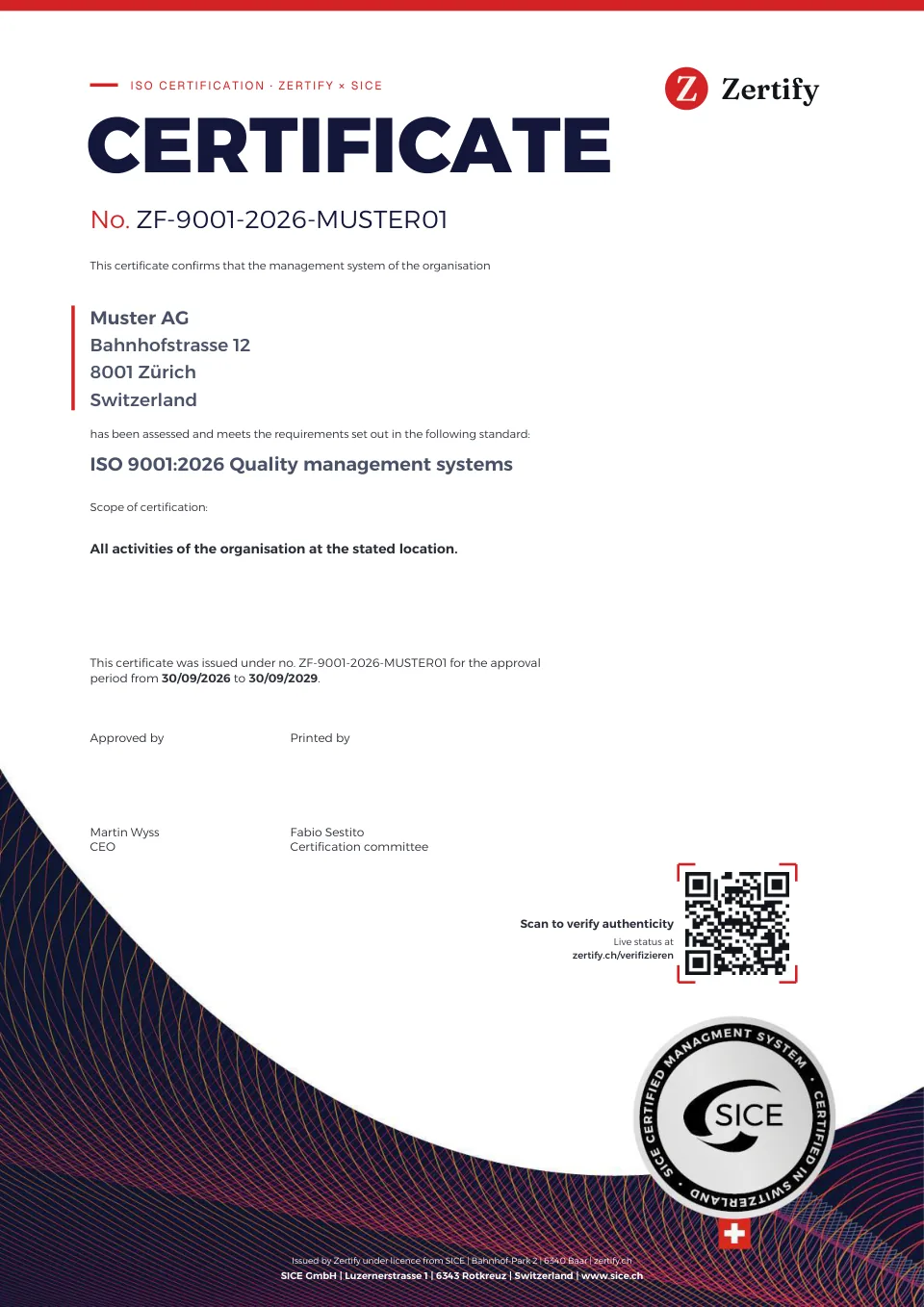
- Certificate as PDFWith number, QR code and the SICE seal. Valid for three years, confirmed by the yearly online re-audit. For customer enquiries, offers and supplier questionnaires.
- Badge for website and documentsFor your website, offers and email signature. One click leads to the verification page; on the website it always shows the current status.
- Public verification pageBy number or QR code, customers see for themselves which company and standard the certificate covers and whether it is valid.
- Evaluation of your assessmentShows which requirements you meet according to your answers and where you should improve.
- Customer accountCertificates, invoices, re-audit and add-ons in one place.
09: Price
Price and validity
First-year price
CHF 749
- From year 2
- CHF 499 per year
- Validity
- 3 years
Your customer requires an audit or an accredited certification? Clarify requirements
Included in the price
- Online assessment with 32 questions
- Certificate as PDF, issued under licence from SICE
- Yearly online re-audit
- Support by email
The verification page shows the status, standard and validity of every certificate. Read more in the FAQ
See the sample and assessment method10: Cost
What does ISO 50001 cost? Audit, consulting or self-assessment
With ISO 50001, consumption, number of sites and metering effort set the price. For a company with 10 to 50 employees, expect roughly these figures.
| Route | Indicative range | What is behind it |
|---|---|---|
| Accredited audit | Indicative rangeCHF 5,000 to 12,000 initial audit, then 2,500 to 5,000 per year | What is behind itThe price follows consumption, the number of significant energy uses and sites. A business with one main consumer is cheap to audit. |
| Consulting and implementation | Indicative rangeCHF 10,000 to 30,000 one-off | What is behind itEnergy data collection, baseline, indicators and savings measures. Metering and energy analysis are often the biggest item. |
| Zertify self-assessment | Indicative rangeCHF 749 in year 1, then CHF 499 per year | What is behind itYou check whether energy review, baseline, indicators, objectives and procurement criteria are demonstrably in place. It does not replace recognised target agreements with authorities. |
All amounts are non-binding indicative ranges for Swiss SMEs, not quotes. Only the providers' own quotes are binding.
11: Duration
How long does ISO 50001 take?
For ISO 50001 consumption data has to be collected first, so the accredited route usually takes six to fourteen months.
| Phase | Accredited | Zertify |
|---|---|---|
| Data and baseline | Accredited3 to 6 months for consumption data, energy review and indicators | ZertifyNone. You answer the questions based on where you stand today |
| Assessment | AccreditedStage 1 and 2, plus walk-through of the significant installations | ZertifyAbout 20 to 30 minutes online, scored immediately |
| Certificate | AccreditedRelease after 2 to 6 weeks, then annual surveillance audits | ZertifyPDF with QR verification within 4 hours |
12: Further questions
Further questions about ISO 50001
Questions
Checklist
ISO 50001:2018 checklist by email
All 32 questions of the ISO 50001 self-assessment as a PDF to tick off, ordered by topic. Free, by email.
13: More standards
More standards
Many companies combine several standards. Two or more earn a discount.
- ISO 14001:2026: View standard
Environmental Management
Energy use is the most common significant environmental aspect, and the two standards share a legal register, objectives and emergency planning.
from CHF 699
- ISO 9001:2026: View standard
Quality Management
Indicators, audits and management review are built identically, so an existing QM system saves a lot of set-up work.
from CHF 599
14: Blog
Latest articles on ISO 50001
15: Questions
Frequently asked questions about ISO 50001
It pays off when energy makes up a noticeable share of costs, for example with cooling, compressed air, heat or data centres. For an office with low consumption the effort usually outweighs the benefit. Look at your energy bill first.
The baseline describes energy consumption over a reference period, usually twelve months. The data comes from electricity bills, meters, fuel deliveries and production figures. Later it serves as the comparison.
These are installations, processes and buildings with high consumption or high savings potential, usually compressed air, cooling, heating, motors and lighting. Only for these does the standard require indicators and objectives.
Not necessarily. What is required is a metering plan that fits significance and data needs. Invoices and existing meters are often enough, for large consumers sub-meters pay off.
It provides methods and data that are required there anyway. The authorities have their own requirements and procedures, though. Clarify what is recognised there before you start, because a self-assessment does not replace a recognised target agreement.
For proposals, supplier questionnaires, many tenders and internal use. It shows that you answered the requirements of the standard in the online assessment and that a member of the SICE Certification Board reviewed your answers. If a tender explicitly requires an accredited certificate, check this first via the Clarify requirements page.
ISO 50001 certificate within 4 hours.
The assessment is free. You pay only once you have passed.
The verification page shows the status, standard and validity of every certificate.